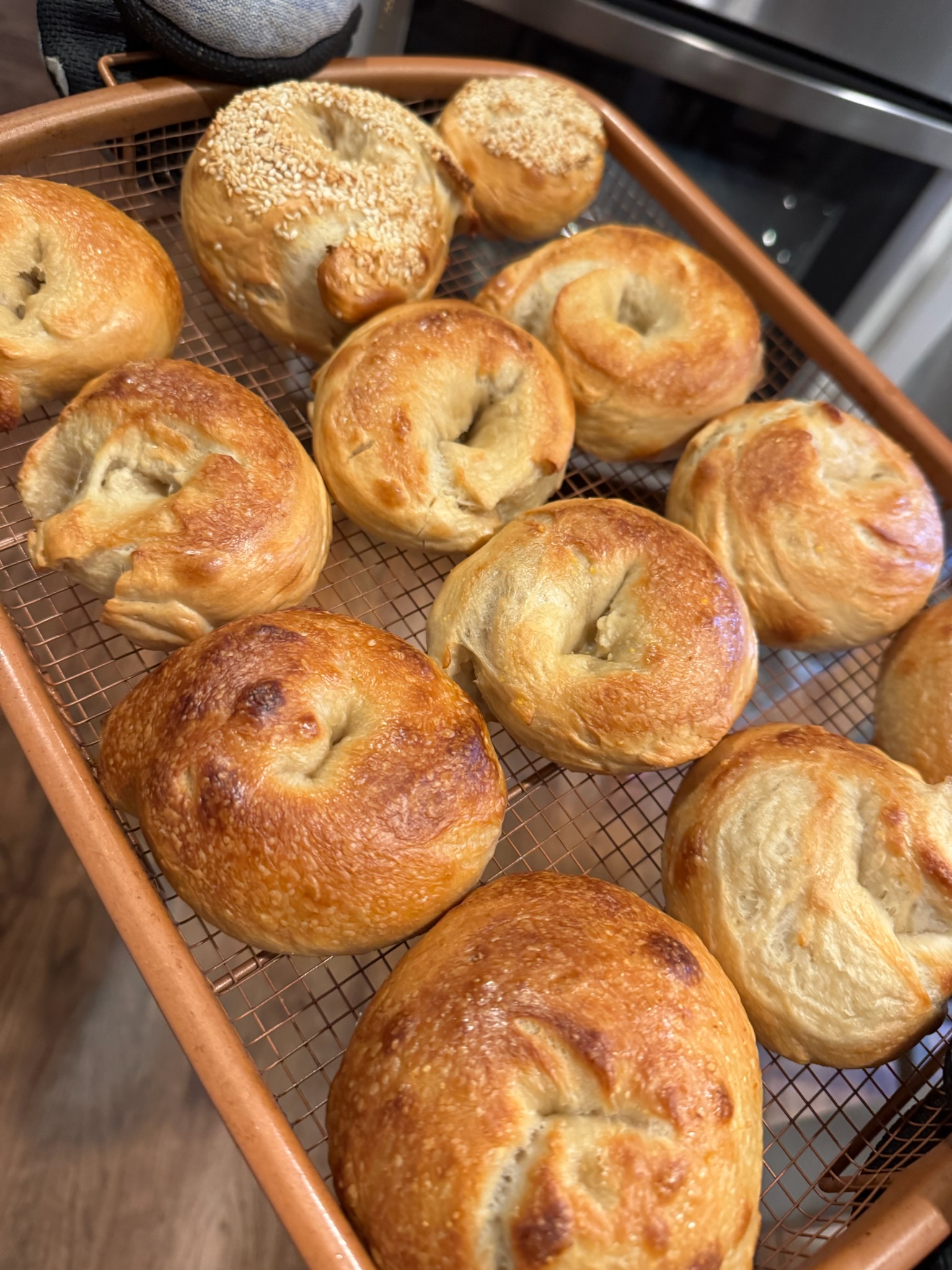
Our Jewish daughter-in-law, a successful mother and businesswoman, has sometimes been criticized for not spending more time in more traditional female roles in the kitchen. She recently decided to deflect that commentary by making bagels from scratch, which is not a trivial task. The recipe had been passed down through her family. The results were so good that popular demand has forced her to take up the task every year during holiday season.
History of Bagels:
Bagels are a big part of Jewish culture. They trace their origins to medieval Eastern Europe in Poland during the Middle Ages.
Although the exact first appearance is debated, the earliest known written mention is from 1610 in Kraków, in community regulations stating that bagels were to be given as gifts to women after childbirth. The distinctive ring shape made them easy to transport on poles or strings, and boiling before baking made them healthier and gave them a longer shelf life—important things in times when fresh bread was a daily necessity and the plaque was still afoot.
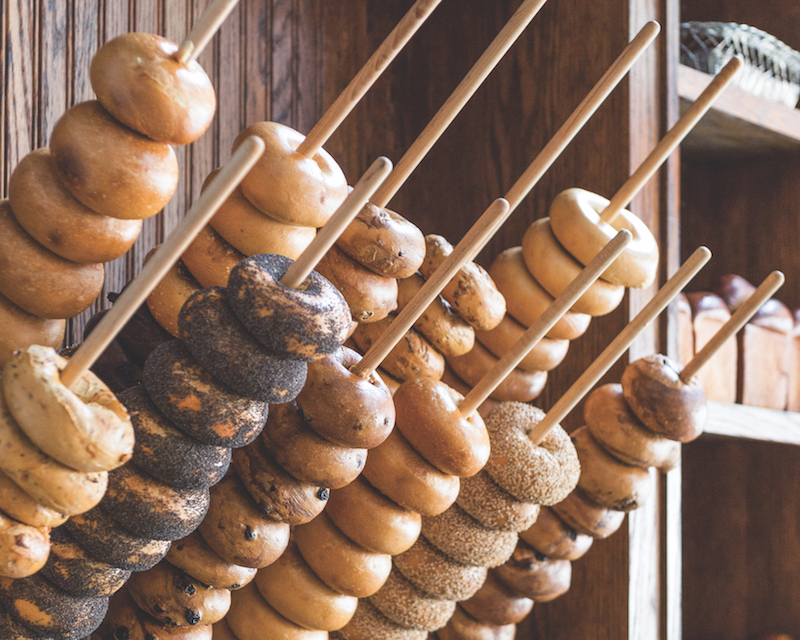
Bagels became central to Jewish culinary tradition for several symbolic and cultural reasons. The circle represented continuity, the cycle of life, and good fortune, which is why bagels appeared at life-cycle events such as births. Additionally, bagels were affordable, filling, and could be made from simple, permitted ingredients—ideal for Ashkenazi communities often facing poverty.
In the late 19th and early 20th centuries, Jewish immigrants carried bagel-making traditions to the United States, especially New York City, where the Bagel Bakers’ Union standardized recipes and techniques. By the mid-20th century, mechanization allowed mass production, transforming what was once an ethnic specialty into a mainstream American food.
Today, bagels remain a symbol of Jewish heritage—a reminder of Eastern European shtetl life, cultural resilience, and the communal rituals that shaped Jewish identity. However, they have also become an important part of the American culinary mainstream where the market in 2024 was $5.6 billion which equates to a consumption of about 40 billion bagels per year.
Tech Info for the Geeks:
A bagel is dense, flavorful, and chewy bread with a hard shell on the outside and a hole in the middle. The density, flavor and chewiness come from the use of high-protein, high-gluten bread. High-gluten flour is somewhat of a misnomer. The name should be “flour that produces high gluten content”. The flour itself has no gluten, rather, it has glutenin and gliadin, which combined with water form gluten molecules. These are magical molecules that link together in every possible way imaginable to form a dense molecular web or mesh (think Spiderman when he really gets wound uo). If yeast – think small animals that like to eat the sugars in the flour and excrete carbon dioxide gas – is added to a flour and water mixture, the gluten mesh traps the carbon dioxide from the yeast and forms bubbles in the dough. The recipe below has diastatic malt powder which is additional food for the yeast and helps with density.
The hard shell comes from boiling the formed dough before baking in water with malt syrup. Boiling serves three important functions. First, it kills any surface bacteria and microbes that might accumulate during the overnight proofing process. Secondly, boiling disturbs the starch molecules on the surface of the bagel and creates a gel which produces a crusty surface and protects the interior dough. It is like waxing your car or putting varnish on raw wood. Finally, the harder shell constricts the amount the dough can rise and helps create the bagel-like density and chewiness of the interior. The malt syrup provides color and shine.
The hole in the middle allows the dense dough to fully cook in the center. It provides more surface area for baking. It also provided an easy way to store and display bagels for sale in the early days.
The Recipe
Quantity: 12 bagels
Ingredients:
- 8 cups of high-gluten flour – about 2 lbs. (try King Arthur Sir Lancelot High-Gluten Flour, or General Mills All Trumps High-Gluten Flour. (Bread flour is also relatively high-gluten and can be used.)
- 2 Tbsp. yeast
- 1 Tbsp. Diastatic Malt Powder (buy at Amazon or Wal-Mart on-line – about $10.00)
- 3 cups warm water (about 105–110°F)
- 1 Tbsp. salt
- 2 Tbsp. (15 ml) barley malt syrup (buy at Amazon or Wal-Mart on-line – about $14) or honey
- 1 Tbsp. baking soda
- 3 qts. water
Toppings (optional)
- Sesame seeds
- Poppy seeds
- Everything seasoning (Trader Joe’s is a good one)
- Coarse salt
Gear:
- Kitchen Aid Stand Mixer
- Pizza or baking stone – about 15” x 18”
- Tongs
- Large sauté pan – 5 qt. is optimal
- Oven mitts
- Drying rack
- Two baking sheets
Procedure:
Making the Dough
- Dissolve yeast in warm water and let sit for five minutes.
- Add flour, salt, malt powder and water/yeast mixture to mixing bowl.
- Mix on low speed for 3 minutes and medium speed for 5 minutes until dough is tough and not sticky. Add a little more water if dough becomes too stiff or dry.
- Hand knead the dough and form into a ball. You should be able for feel some warmth in the dough as the gluten begins to form.
- Clean and lightly grease the mixing bowl. Put the dough ball into the bowl and cover for one hour.
Forming the Bagels:
- Divide the dough into 12 equal size balls.
- Roll each ball into a cylinder about 10” long. Wrap each cylinder around the knuckles of your hand with ends coming together in your palm. Rub your palm on the counter to seal the circle. Remove and place on a baking sheet which has been sprinkled with cornmeal. (grease instead?)
- Cover baking sheets tightly in plastic and store in refrigerator overnight or at least six hours.
Final Prep and Baking:
- Insert baking stone into the oven and preheat to 475F degrees.
- Bring 3 quarts of water to boil in the sauté pan, adding the malt syrup while the water is heating, stirring to help dissolve.
- Remove bagels from refrigerator. Boil bagels for 45 seconds on each side. Remove and set on drying rack for one minute.
- If using toppings, lay them out on small plates and dip boiled bagel into the topping and return to drying rack, topping side down.
- Place the six bagels on the stone and bake for 12 minutes or until golden brown.
- Repeat process for the second batch of six bagels.
Make sure the cream cheese is close by!
Categories: Classic Chinese Dishes, Classic Jewish Recipes, Classic Recipes by Type
 Bravado Cooking
Love it!!!